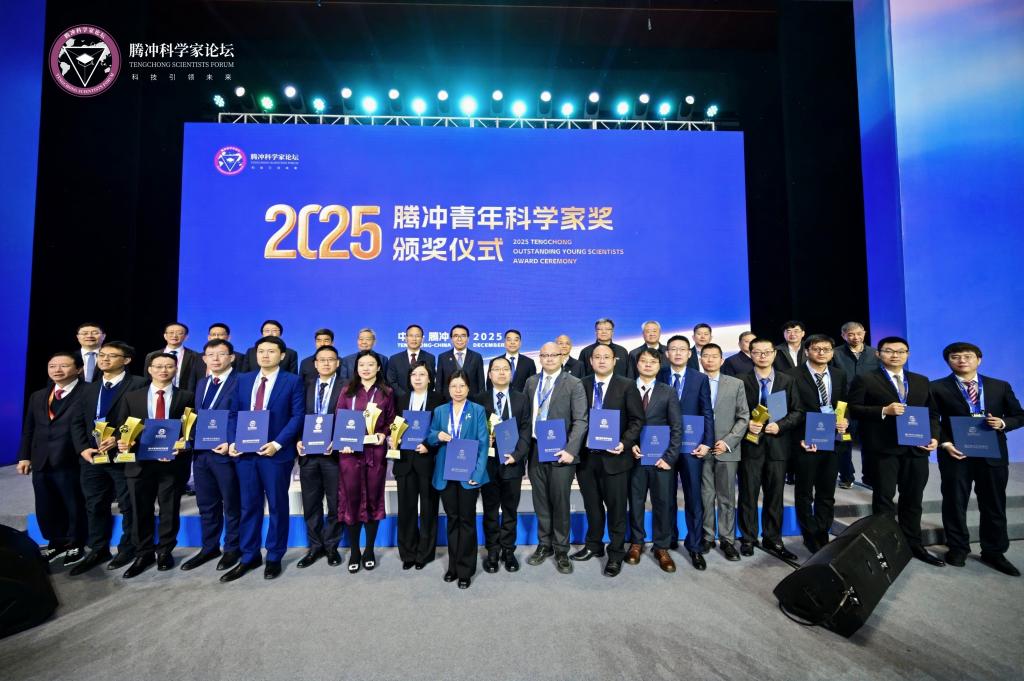
Carrying forward the spirit of the Southwest Associated University and empowering the growth of young talent. On 5 December, the inaugural ‘Tengchong Outstanding Young Scientists Award’ ceremony was held in Tengchong, where the winners gathered in this ‘city at the edge of the world’, bathed in the warm winter sunshine of December, to celebrate their moment of glory.
The evaluation process for the Tengchong Outstanding Young Scientists Award strictly adheres to the principles of ‘fairness and impartiality, innovation-oriented, and prioritising potential’. Nominating experts conduct a thorough assessment based on four core dimensions—innovation and breakthroughs, academic influence and recognition, social value and practical application, and development potential and leadership—fully aligning with the award’s purpose of recognising outstanding innovative potential and supporting the growth of young scientific and technological talent. Following review through the relevant academic procedures of the Tengchong Scientists Forum, nine awardees and nine nominees have been selected.
I. Awardeeof the 2025 TengchongOutstandingYoung ScientistsAward
(1) Mathematics, Physics and AstronomySciences
Wang Jianwei Boya Distinguished Professor, School of Physics, Peking University
Reason for the award: For pioneering work in the physics and technology of integrated photonic quantum chips, which has laid the technical foundation for the realisation of large-scale quantum computing and quantum networks.
General Overview: Field of research: the physics, technology and applications of optical quantum chips, including large-scale integrated optical quantum chips, hybrid discrete-continuous quantum chips, and hybrid photon-atom integrated chips. Research focuses on cutting-edge applications such as quantum computing, quantum simulation and quantum networks.
(2)materials sciences
Qian Xiaoshi Distinguished Professor at the School of Mechanical and Power Engineering, Shanghai Jiao Tong University; Executive Deputy Director of the Centre for Advanced Interdisciplinary Research
Reason for the award: By establishing the new paradigm of ‘polarised high entropy’, this work has overcome the traditional bottlenecks associated with the electric-caloric cooling effect—namely, low temperature range, short lifespan and system complexity—thereby laying the groundwork for the practical application of solid-state cooling technology across the entire chain, from theory and materials to system-level implementation.
General Overview: We have long been dedicated to research into ferroelectric (electric-caloric) refrigeration technology. Drawing on phase transitions in condensed matter as our theoretical foundation, utilising the design and preparation of polar functional materials as our innovative approach, and focusing on thermodynamic cycles and the manufacture of solid-state refrigeration systems as our application areas, we conduct interdisciplinary research spanning theory, materials and systems.
(3) Life Sciences
Wu Dongdong Research Fellow, Kunming Institute of Zoology, Chinese Academy of Sciences; Deputy Director, Kunming Institute of Zoology, Chinese Academy of Sciences; Director, State Key Laboratory of Genetics, Evolution and Animal Models
Reason for Award: Led the primate genome project, mapped phylogenetic trees, resolved controversies, discovered hybrid speciation events, and revealed the evolutionary mechanisms underlying primate brain and social behaviour, thereby laying a crucial foundation for the conservation, research and utilisation of non-human primates.
General Overview: Focusing on primates as research subjects, he conducts interdisciplinary research to explore the origins and evolutionary genetic mechanisms of complex traits in primates, thereby promoting the application of non-human primates in the biomedical field. As an initiator, he spearheaded the International Primate Genome Project.
(4) Medical and Pharmaceutical Sciences
Li Hanjie Researcher, Shenzhen Institute of Advanced Technology, Chinese Academy of Sciences
Reason for Award: Charted the spatiotemporal developmental atlas of the human immune system; demonstrated the existence of novel immune cells in peripheral tissues that possess the molecular and developmental characteristics of microglia; proposed that these cells, together with central nervous system microglia, constitute the ‘microglia lineage’; thereby overturning the century-old conventional understanding that microglia are unique to the central nervous system.
General Overview: With long-standing dedication to human immunology research, he has, for the first time internationally, constructed a high-resolution spatiotemporal atlas of early human immune cell development, discovering multiple new immune cell subpopulations and elucidating their functions. He has identified a microglial lineage with unique developmental origins and molecular phenotypes in multiple peripheral human tissues and revealed its functions, thereby correcting the century-old assumption that “microglia are confined to the central nervous system”.
(5) Information and Intelligent Sciences
Xu Zhanbo Professor, School of Automation Science and Engineering, Xi’an Jiaotong University
Reason for Award: Innovated theories and methods for the optimised design and operation of zero-carbon energy systems, ensuring both zero-carbon energy supply and economic viability. Constructed and commissioned the world’s first hydrogen-powered zero-carbon smart energy system, providing a practical and innovative technological pathway towards the nation’s ‘dual carbon’ goals.
GeneralOverview: Focusing on application contexts such as buildings and ICT infrastructure, his research addresses issues including the intelligent structural design and system optimisation of zero-carbon smart energy systems. He has led over ten national-level projects, including sub-projects under major National Natural Science Foundation of China (NSFC) programmes, the NSFC Outstanding Young Scientists Programme, and the National Defence Science and Technology Innovation Special Zone Programme, as well as corporate projects for State Grid, Huawei, China Mobile and China State Construction Engineering Corporation.
(6) Advanced Manufacturing Sciences
Li Tiefeng Professor, Centre for Interdisciplinary Mechanics, School of Aeronautics and Astronautics, Zhejiang University; Executive Vice-Dean, Institute of Fundamental Interdisciplinary Research
Reason for Award: Unveiled the driving mechanisms behind extreme deformation in soft materials; developed design principles for soft materials and soft robots in extreme environments; and provided new principles and methods for deep-sea robots and specialised equipment to meet major national needs.
GeneralOverview: Engaged in research on the mechanics of soft matter in extreme environments and intelligent robotic systems, he has successfully conducted exploration and propulsion experiments with a shell-less soft robot at a depth of 10,000 metres in the Mariana Trench and deep-sea navigation trials in the South China Sea (featured on the cover of *Nature*). His work was reported on *Xinwen Lianbo* (China Central Television’s evening news) and was selected as one of the Top Ten Scientific Advances in China in 2021.
(7) Aerospace Sciences
Liang Xinxin Researcher, Beijing Institute of Aerospace Systems Engineering
Reason for Award: Inter-medium rockets represent a new class of rockets characterised by their technical complexity. Through his innovations in rocket system design and inter-medium flight technology, the awardee has significantly enhanced the rockets’ long-range delivery capabilities and their adaptability to complex launch environments, making an outstanding contribution to the innovative development of this new class of rockets in China.
General Overview: Engaged in comprehensive design and ballistic design research for cross-medium rockets, proposing innovative overall rocket designs and cross-medium flight technologies that have significantly enhanced the rocket’s long-range delivery capabilities and adaptability to complex launch environments, thereby providing strong support for the research and development of China’s new generation of advanced rockets.
(8) Ecological Environment and Earth Sciences
Cai Shuhui Researcher, Institute of Geology and Geophysics, Chinese Academy of Sciences
Reason for Award: Established a domestic research system for the magnetism of faint extraterrestrial samples and applied it to the study of lunar regolith from the Chang’e missions; discovered that the Moon’s magnetic field strength rebounded 2.8 billion years ago and that a weak magnetic field persisted 2 billion years ago; revealed that the lunar geomagnetic dynamo operated at least until the mid-evolutionary stage; demonstrated that the Moon’s interior retained significant heat during the mid-evolutionary period; and updated our understanding of the lunar dynamo and thermal evolution.
GeneralOverview: Research focuses primarily on the evolution of the Earth’s and Moon’s magnetic fields and internal dynamic processes. Obtained key evidence regarding the evolution of the Moon’s magnetic field during its mid-evolutionary stage and on its far side; discovered that the Moon’s magnetic field strength rebounded 2.8 billion years ago and that a weak magnetic field persisted 2 billion years ago; revealed that the Moon’s geomagnetic dynamo operated at least until the mid-evolutionary stage; demonstrated that the Moon’s deep interior retained significant heat during the mid-evolutionary stage; and updated existing understanding of the Moon’s geomagnetic dynamo and thermal evolution.
(9) Arts and Interdisciplinary Sciences
Huang Xiaoqiang Distinguished Researcher and Assistant to the Dean, School of Chemistry and Chemical Engineering, Nanjing University
Reason for Award: Developed strategies for the integration of biology and chemistry, created several distinctive photoenzyme and electroenzyme catalytic systems, provided effective solutions to the challenge of precise radical control in chemistry, broke through the natural catalytic limits of biological enzymes, and empowered green biomanufacturing.
GeneralOverview: Dedicated to interdisciplinary research at the intersection of chemical and biocatalysis, he has successfully established distinctive photoenzyme and electroenzyme catalytic systems, providing new methods for the asymmetric synthesis of chiral molecules. A series of achievements, for which he served as the last corresponding author, have been published in journals such as *Nature* (3 papers) and *Nature Catalysis* (3 papers), and he has received awards including the Science Exploration Award (2025) and the DAMO Academy Qingcheng Award (2024).
II. Nominees for the 2025 Tengchong Outstanding Young Scientists Award
(1) Mathematics, Physics and Astronomysciences
Wang Meng Professor and Deputy Dean of the School of Physics, Sun Yat-sen University; Deputy Director of the Guangdong Provincial Key Laboratory of Magneto-Electric Property Analysis and Devices
Reason for the award: The first experimental discovery of a high-temperature superconductor in the liquid nitrogen temperature range based on nickel oxides, which sparked a series of research advances, established nickel oxides as a completely new class of high-temperature superconducting materials, and advanced research into the microscopic mechanisms of high-temperature superconductivity.
General Overview: Research interests include the physical properties and mechanisms of unconventional superconducting materials and quantum magnetic materials. Research methods encompass material growth, neutron scattering, high-pressure techniques and Raman scattering. He spearheaded and participated in the construction of China’s first high-energy inelastic neutron scattering time-of-flight spectrometer. In 2023, led the team that discovered a nickel oxide high-temperature superconductor reaching the liquid nitrogen temperature range under pressure.
(2)materials sciences
Pan Qingsong Researcher, Institute of Metal Research, Chinese Academy of Sciences
Reason for the award: Proposed an original and innovative strategy for high-performance metallic materials based on ‘elementary units–spatial order–transformative properties’, breaking through the traditional framework of alloying research. This successfully resolved the century-old dilemma of ‘trade-offs’ in material properties, achieving a ‘1+1>2’ leap in comprehensive mechanical properties, and demonstrates significant pioneering, economic and strategic value.
General Overview: Long-standing commitment to the design, preparation and performance regulation of metallic structural materials. Pioneered the innovative concept of cross-scale, element-scale spatial gradient ordered structures for strengthening and toughening metals, breaking through the traditional research framework reliant on alloying and homogenisation. Successfully resolved the century-old dilemma of trade-offs in material properties, achieving a ‘1+1>2’ leap in comprehensive mechanical properties, and opening up a new direction in the research of element-scale gradient ordered structure metals.
(3)Life Sciences
Guo Xiaojiao Associate Researcher, Institute of Zoology, Chinese Academy of Sciences
Reason for the award: The discovery of the locust aggregation pheromone 4VA and the elucidation of its biosynthetic and signal transduction pathways have not only unveiled the scientific mysteries behind locust swarming and outbreaks, but have also enabled precise artificial manipulation of pheromone synthesis and release, as well as locust swarming behaviour, thereby providing a breakthrough technological direction for locust pest control.
General Overview: Focusing on locust phase transition and swarming behaviour, she has conducted systematic research into the behavioural changes, physiological regulation, neural coding and genetic regulation underlying swarming in migratory locusts, revealing the mechanisms of communication and interaction among individuals within insect populations. Currently leads a project under the National Natural Science Foundation of China’s Excellent Young Scientists Fund, and has undertaken research tasks for the Chinese Academy of Sciences’ Strategic Priority Research Program (Category A) and the National Key Research and Development Programme.
(4)Medical and Pharmaceutical Sciences
Chang Lingqian Professor and Deputy Dean of the School of Biomedical Engineering, Beihang University; Director of the Ministry of Industry and Information Technology Key Laboratory of Big Data Precision Medicine
Reason for the award: Original development of nano-electroporation technology; through the interdisciplinary integration of physics and medicine, this has revolutionised traditional drug delivery paradigms, pioneered new pathways for cell-targeted precision diagnosis and treatment, and improved the clinical treatment efficacy of diseases such as cancer and organ damage.
GeneralOverview: Pioneered the nanoscale electroporation technique; through the interdisciplinary integration of physics and medicine, this innovation has revolutionised traditional drug delivery paradigms, pioneered new pathways for cell-targeted precision diagnosis and treatment, and enhanced the clinical efficacy of treatments for diseases such as cancer and organ damage.
(5)Information and Intelligent Sciences
Zhang Man Professor and Deputy Dean, School of Artificial Intelligence, Beijing University of Posts and Telecommunications
Reason for the award: Focusing on the field of artificial intelligence and adopting a human-centred approach, she has established a holistic framework of ‘human perception–generation–interaction’. This framework has achieved breakthroughs in end-to-end technologies for multimodal human perception, the generation of interactive digital humans, and human-space interaction, thereby providing support for fields such as smart cities and cultural computing. The work demonstrates both technological innovation and industrial applicability.
GeneralOverview: Primary research interests include artificial intelligence, computer vision and pattern recognition. She has led the research and development of numerous national and provincial-level projects, including the National Key Research and Development Programme, General Projects of the National Natural Science Foundation of China, and the Beijing Municipal Science and Technology Commission’s Artificial Intelligence Special Project.
(6)Advanced Manufacturing Sciences
Zhao Cang Associate Professor, Department of Mechanical Engineering, Tsinghua University
Reason for the award: Pioneered innovative approaches to research in metal additive manufacturing, providing significant guidance on the suppression of micro-defects, microstructural control and long-life design for the additive manufacturing of critical components such as aeroengine turbine discs.
General Overview: Specialises in in-situ monitoring and theoretical research on metal laser additive manufacturing. As a key contributor, designed and constructed the world’s first synchrotron X-ray in-situ real-time monitoring platform for metal additive manufacturing, and has conducted in-depth research into fundamental issues in laser additive manufacturing, including keyhole morphology evolution, molten droplet spatter, keyhole bubble defects, and laser melting modes.
(7)Aerospace Sciences
Du Wenbo Professor, Beihang University
Reason for the award: For discovering the mechanism of ripple propagation in dynamic, time-varying civil aviation traffic networks, and for inventing a partitioned optimisation method for the control of large-scale air traffic flow; making significant contributions to elevating the standard of unified control of China’s civil aviation traffic networks to the forefront of the world.
General Overview: Engaged in long-term research on air traffic operations and control, developing theoretical frameworks and methodologies across three levels—‘network ripple effects → traffic flow control → flight separation’—to address causal inference and prediction of network ripple effects, distributed optimisation of air traffic flow control, and the maintenance of balanced flight separation in congested airspace. Developed core systems that have been successfully applied in major national projects, including civil aviation and transport preparedness.
(8)Ecological Environment and Earth Sciences
Wang Zaicong Professor, China University of Geosciences (Wuhan)
Reason for the award: Pioneered new approaches and techniques for studying the evolution of volatile components in Earth-like bodies through research on copper-affinity elements; revealed that the giant impact responsible for the Moon’s formation resulted in the loss of volatile elements on a lunar-wide scale; proposed that the accreted material following this event provided the Earth with substantial amounts of water and other components conducive to habitability; and challenged the traditional view that the interior of Mars is highly sulphur-rich.
General Overview: Research focuses primarily on the geochemistry of copper-affinity elements and the stratigraphic differentiation and evolution of Earth and Earth-like celestial bodies. Developed a suite of high-precision element-isotope analytical techniques, achieving outstanding results in the early accretionary evolution of Earth and the origin of volatile components, crust-mantle stratigraphic differentiation and interactions, massive gold mineralisation, and the study of lunar regolith from the Chang’e-5 and Chang’e-6 missions.
(9)Arts and Interdisciplinary Sciences
Liu Zhiyuan Researcher, Shenzhen Institute of Advanced Technology, Chinese Academy of Sciences
Reason for the award: Dedicated to research into flexible bioelectronic materials and devices, discovered novel stretchable conductive systems, proposed a development path for flexible electrodes from ‘flexibility’ towards ‘actuability and responsiveness’, and pioneered a new direction for next-generation brain-computer interfaces with the ‘neural worm’, driving flexible bioelectronics from passive compliance towards active adaptation.
GeneralOverview: Serves as principal investigator on projects including the National Key Research and Development Programme, the Shenzhen Peacock Team, and initiatives under the Major Projects Bureau of the Chinese Academy of Sciences. For over a decade, the research group has specialised in flexible human-machine interface systems and their applications, encompassing next-generation soft electrodes for peripheral neuromuscular interfaces (both surface-mounted and long-term implantable), soft-hard interfaces, hardware development and application validation; as well as soft tactile skin technology for humanoid robots.